lightning nowcasting ai / ● alpha
Bronte Nowcaster
Calibrated, sub-hour deep learning that answers the question that matters on a flight line or launch range: how likely is a lightning strike at this point in the next 30 minutes — refreshed every 5.
- 0.331
- CSI — most accurate of 8 architectures
- 0.006
- Expected Calibration Error (tied-best)
- 5 min
- Refresh cadence, out to a 30-min horizon
- 11,476
- CONUS storms in peer-reviewed validation
 Try the live demo
The problem
Lightning is a leading cause of weather-driven disruption at military airfields and spaceports. When cloud-to-ground lightning moves within five nautical miles, crews must clear the flight line, stop refueling and munitions handling, and pause launch processing. The decision that matters lives in the next half hour — yet today’s tools serve that window poorly. Large-scale weather models forecast the environment days to months out, while radar and lightning sensors only confirm strikes already happening. Between them sits a structural gap: no fielded, calibrated, point-specific probability for the next 5–30 minutes.
Our approach
- •A-CCU architecture – an Attention-ConvLSTM-Conv U-Net that ingests the satellite, radar, and lightning data the Department already receives and predicts where lightning will occur over the next 30 minutes.
- •Calibration as a first-class objective – reliability is built into model selection, not patched on afterward, so a stated “30%” verifies near 30% of the time — safe to base a go/no-go call on.
- •5-minute, sub-hour resolution – forecasts refresh every 5 minutes out to 30, the neighborhood-scale interval operators actually decide on and the one most existing tools miss.
- •Software only – no new sensors and no new hardware at the installation. It runs on data feeds bases already have, so each new site is mainly setup and accreditation, not a new build.
Validated skill
On the national SEVIR archive — 11,476 storms at 5-minute cadence — the A-CCU was the most accurate of eight competing architectures and among the most reliable, with formal statistical testing. In a stratified re-analysis it beat the persistence benchmark in all 15 independently trained copies beyond 5 minutes, and detected 36–42% of first strikes at points with no prior lightning — exactly where simpler methods score zero.
Skill holds as lead time grows
Critical Success Index vs. forecast lead time. The A-CCU beats persistence at every step beyond 5 min — 2.3× its skill at +30.
Probabilities you can trust
Reliability curve — when the model says 30%, lightning happens ~30% of the time (ECE 0.006). Closer to the diagonal is better.
What makes it different
Most sub-hour lightning products are hourly, uncalibrated, or depend on ground radar. Bronte Nowcaster is calibration-first, satellite-based — so it can deploy to data-sparse or expeditionary sites — and produces 5-minute guidance to a 30-minute horizon at roughly 91 forecast sequences per second, ample headroom for real-time, multi-site operation. That trust-first posture is the right one for high-consequence flight-line and range decisions.
Status
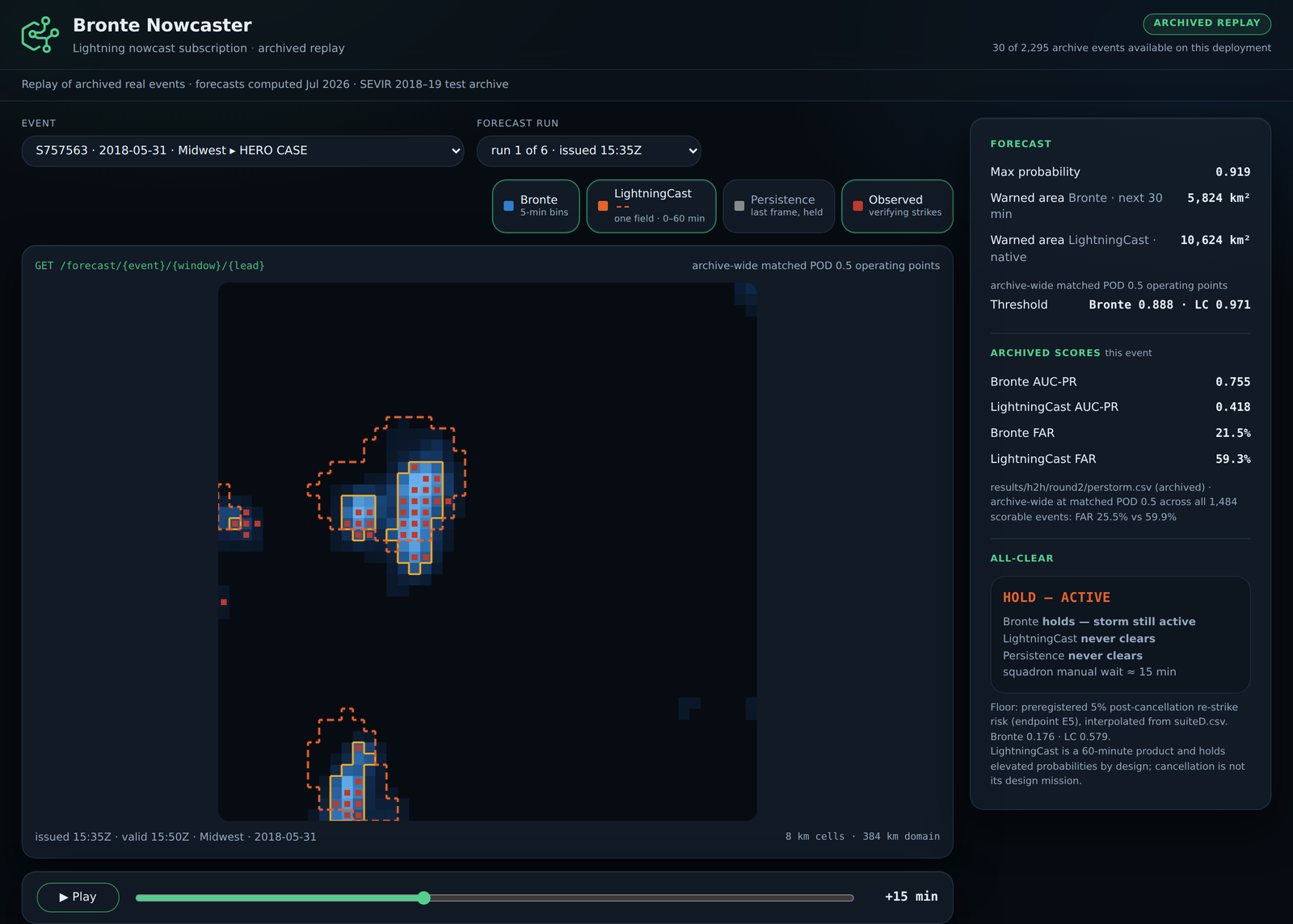
Bronte Nowcaster is an active research and development effort, built on work developed under an Air Force research grant (AFOSR 23AFCOR003). We are pursuing an operational demonstration across two convective seasons at high-lightning-activity military installations — candidate sites include the nation’s space-launch ranges and Gulf Coast airfields — to prove its peer-reviewed skill holds on live data and in the hands of working weather officers. A public demo of the service is running now at bronte.sudo-rndm.ai, replaying real archived storms through the same interface the demonstration will field.